



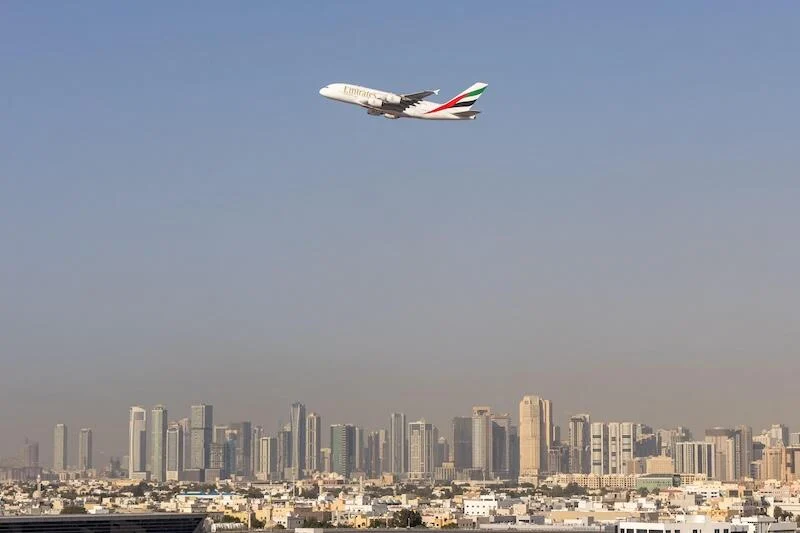
Credit: Markus Mainka/Alamy Stock Photo
LISBON, Portugal—The General Civil Aviation Authority (GCAA) of the UAE has been at the center of intense efforts to keep airspace open and air traffic flowing during the Iran conflict, with air traffic control officials adopting a new approach to civil-military collaboration.
The scale of the impact on traffic has been huge, Ahmed Al Jallaf, the GCAA’s assistant director general of air navigation services, told delegates at the Civil Air Navigation Services Organization Leadership Summit in late May in Lisbon.
Flight movements dropped from a normal 3,000 to 3,400 per day in UAE airspace to just 29 on March 1, the day after the conflict began.
“We had restricted airspace operations, but we did not fully close our airspace,” Al Jallaf said. “The first 24 to 48 hr. were the time the airspace users needed to assess the security of their operations.”
The Emirates Flight Information Region (FIR) is controlled by the UAE’s air traffic control service from the Sheikh Zayed Air Navigation Center located near Abu Dhabi International Airport. Over the past two decades this high-density airspace, covering an area of 124,000 km2 (35,000 nm2), has become a vital east-west air corridor, serving the busy Gulf region and supporting Europe-Asia traffic flows. Some 51% of the FIR is designated as military airspace in normal times, with civilian traffic allowed to use part of that at times by the military.
As the country closest to Iran, with just a few dozen miles separating them across the Strait of Hormuz, the UAE has effectively been at the front line of the war. The UAE has been subject to more than 3,000 Iranian attacks by ballistic missiles and drones.
As is usual in a conflict involving air defense, the UAE immediately activated its Emergency Security Control of Air Traffic Plan. “This basically means all airspace becomes military airspace,” Al Jallaf told Aviation Week in an interview in Lisbon. A high level of cooperation between the UAE military and their civil air traffic control counterparts is a key factor in the country being able to resume civilian flights rapidly.
GCAA has taken a different approach during this conflict. It has shifted from the standard method of making an airspace request to the military and waiting for the answer. Instead, Al Jallaf explained, it sought to understand the problem first by engaging at management level before making any request, and “then present options framed around what is operationally possible for them.”
“That level of understanding has allowed us to gradually open more areas toward a more flexible use of airspace and loosen the operations. It is not a secret that the aviation infrastructure has been targeted several times, which adds more complications and challenges to our resumption of operations,” he continued.
“The airspace capacity was reviewed daily and enhanced and increased with the collaboration of our military authorities. That level of maturity is for me a success, a best practice,” Al Jallaf said.
By March 3, the UAE saw 290 daily movements rising to 1,600 by mid-April with 2,000 by May 24.
“This was not an improvisation, it was a methodology any ANSP [air navigation services provider] can replicate,” he added.


 French