



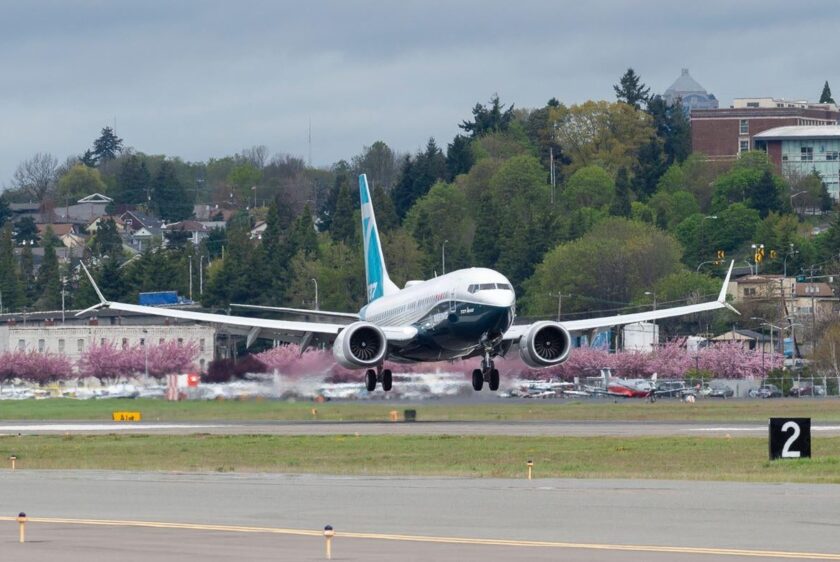
Boeing says certification of the 737-7 and -10 is in its final phases and remains on track for later this year but confirms its earlier expectations that first deliveries of the final pair of 737 MAX variants will not begin until 2027.
Although the extended delivery schedule is in line with recently stated entry-into-service timeline forecasts from future 737-10 operators including Delta Air Lines and United Airlines, Boeing’s latest update reflects the large volume of certification work still facing the company.
Commenting on progress towards regulatory approvals for the 737-7 and -10, Boeing president and CEO Kelly Ortberg says the company is in “the final phases of the certification and flight test for the 737-10, which includes autothrottle, autopilot, enhanced angle-of-attack, as well as the engine anti-ice solution.”
“We’re pleased with the progress so far and remain on plan for the new members of the 737 MAX family to be certified later this year, with deliveries expected to start in 2027,” he adds. The latest round of certification flight tests comes after Boeing received FAA approval for Type Inspection Authorization (TIA) Phase 2, the company says.
The 737-7 first flew in March 2018 and wrapped up formal FAA flight testing in late 2021. But the variant’s certification program has been prolonged by new FAA requirements and paced by an engine anti-ice redesign issue. The 737-7 is still expected to earn certification before the 737-10, which first flew in June 2021.
Also providing a status update on the long-delayed 777-9 as part of a broadly upbeat first quarter earnings call, Ortberg says Boeing recently received FAA approval for TIA 4a certification flight testing. Although not “a super large package” of test work, Ortberg adds Phase 4a is important because it includes certification for natural icing.
“We want to get that de-icing done while there’s still ice available in Alaska. So that was an important one for us to get so that we don’t have to search for weather,” says Ortberg. “The next one will be TIA 4b. We are expecting that very soon, and that’s a pretty large package. Watch for that milestone; achieving 4b will be important for us to continue the flight test.”
777-9’s GE9X Durability
Commenting on the engine durability issue with the 777-9’s GE Aerospace GE9X mid-seal first revealed by Boeing in January, Ortberg says, “GE’s got a fix that they’re working for that, and so that’s not impacting our flight test program.” He adds, however, that “we’re having to do periodic inspections, but we’re able to incorporate that and keep the airplanes flying.”
Remarking on the same issue at GE Aerospace’s quarterly earnings call on April 21, the engine maker’s chairman and CEO Larry Culp said, “we think we are at root cause, and we’re finalizing the modification as we speak. We’ve been fully transparent with Boeing and the FAA every step of the way.”
Neither Boeing nor GE anticipate any impact on deliveries because of the seal modification. “Currently, we’re continuing to build up and assembly to the point of the mid-seal. We’re modifying the tooling and ramping some suppliers for the modified part. We’ll end up having deliveries that will end up more weighted in the second half,” says Culp.
“We just have a lot of work yet to do here with this [777-9] program,” says Ortberg. “This is going to be a big focus area for us over the balance of the year, GE is also working with this mid-seal issue that we’ve identified, and it will require an update to the engines before delivery. We’re still working through the industrial plan to get all the engines upgraded to support to support delivery,” he adds.
Rate Ramp, Delivery Plans
From a production perspective, Boeing expects to increase 737 assembly from the current 42 per month to 47 per month “by this summer,” says Ortberg. “I feel pretty, pretty good about that. We still benefit from high levels of inventory,” he adds. Preparations meanwhile continue for the next rate rise to 52, which will be driven by the start of 737 production on the company’s new “North” line in Everett, Washington.
The North line “is expected to begin operations later this year at a low rate of initial production to demonstrate conformity to the FAA that will allow operations under our current production certificate,” says Boeing EVP and CFO Jay Malave. “Following completion of these initial units, we will be led by our safety and quality plan to increase rate to 52 per month when the entire production system is ready.”
Overall, Boeing delivered 114 737s in the first quarter and completed rework on all 25 aircraft identified with wiring damage earlier in March. “We remain on track to deliver 500 airplanes this year,” says Malave, who indicates that Renton production teams achieved “a nearly 20% reduction in final assembly rework hours as compared to the first quarter of 2025.”
Deliveries of 787s remain on track for between 90 and 100 aircraft for the year, despite only 15 aircraft being handed over to operators in the first quarter. “Although seat certifications impacted deliveries in the quarter, we are working with the FAA and our customers to address these risks by partnering earlier in the development process and creating contractual off ramps to avoid delivery delays in the future,” says Malave. Production at North Charleston, South Carolina, is close to stabilizing at eight per month
Rework hours on the 787 lines improved over the first quarter of 2026 by more than 25% compared to the first quarter of 2025, Boeing says. “These gains in the factory come even as our stability is being paced by the supply chain, where we don’t enjoy the same buffer as we have on 737,” says Malave. “We are closely working with our suppliers, including forward deploying resources to support their recovery plans. We continue to expect an increase to 10 per month later this year.”
War Effects
Ortberg meanwhile played down the potential effects of the ongoing Iran war on the commercial side of the company. “We have seen no impact so far. No customers are requesting changes in their deliveries. We made deliveries in the first quarter to the important customers there in the Middle East,” he notes.
Around 14% of Boeing’s commercial order backlog by units is held by operators in the Middle East. “But two thirds of that backlog deliver out in 2030 and beyond, and we have pretty good ability to re-sequence airplanes in a 12-to-18-month time frame. So, I think we’ll be okay, we’ll manage through that,” says Ortberg, who adds that some operators have called to say, “they’re willing to pull forward if there’s any opportunity.”
“The broader thing for us to watch is the overall impact of fuel prices and jet fuel price, and whether that hits the aftermarket. We’re less susceptible to the aftermarket, as it is a smaller part of our overall portfolio going forward,” says Ortberg.
For its quarterly earnings, Boeing reported sales rose 14% to $22.22 billion while net losses narrowed over the first three months to $7 million, compared to a loss of $31 million for the same period in 2025.


 French